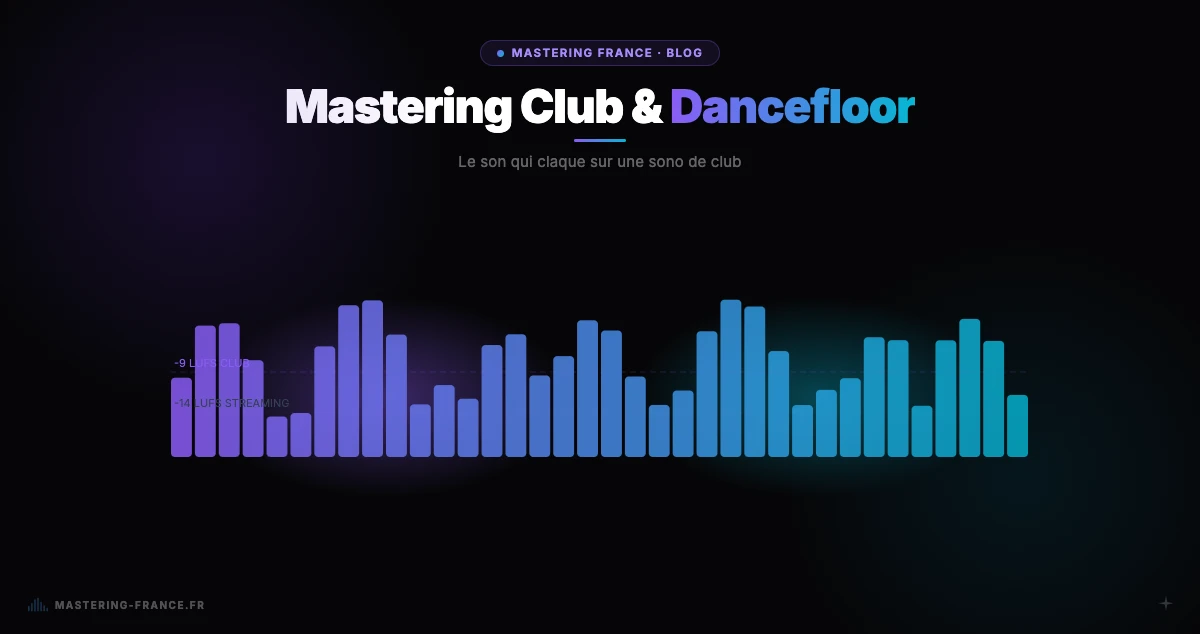
Club specifics: a dancefloor master targets between -8 and -6 LUFS, with True Peak at -1 dBTP, mono bass below 100 Hz, and moderate compression preserving transients. These parameters are the opposite of streaming targets.
Your track sounds perfect on your studio speakers. But in a club, on a 20,000-watt PA system, the bass seems muddy, the kick lacks punch, and everything sounds weak and flat. This isn't a mixing problem — it's a club mastering problem.
Mastering for club playback doesn't follow the same rules as streaming. This guide explains exactly how to optimize your sound for a professional dancefloor — techno, house, drum & bass, garage, trance.
Why club mastering is different from streaming
PA systems: a different physics
On a professional club PA system — speakers covering 20 Hz to 20 kHz with several thousand watts — the goal isn't loudness normalization. It's physical impact, sub-bass power, and legibility at very high sound pressure levels on a dance floor. These systems reproduce frequencies your studio speakers simply cannot — especially below 40 Hz.
No automatic normalization
DJ sets don't go through Spotify or Apple Music's automatic normalization. A DJ mixes in real time and can adjust volume on the mixer. Club convention is to master louder so the DJ doesn't have to raise the gain — which introduces noise and reduces quality.
Target parameters for a perfect club master
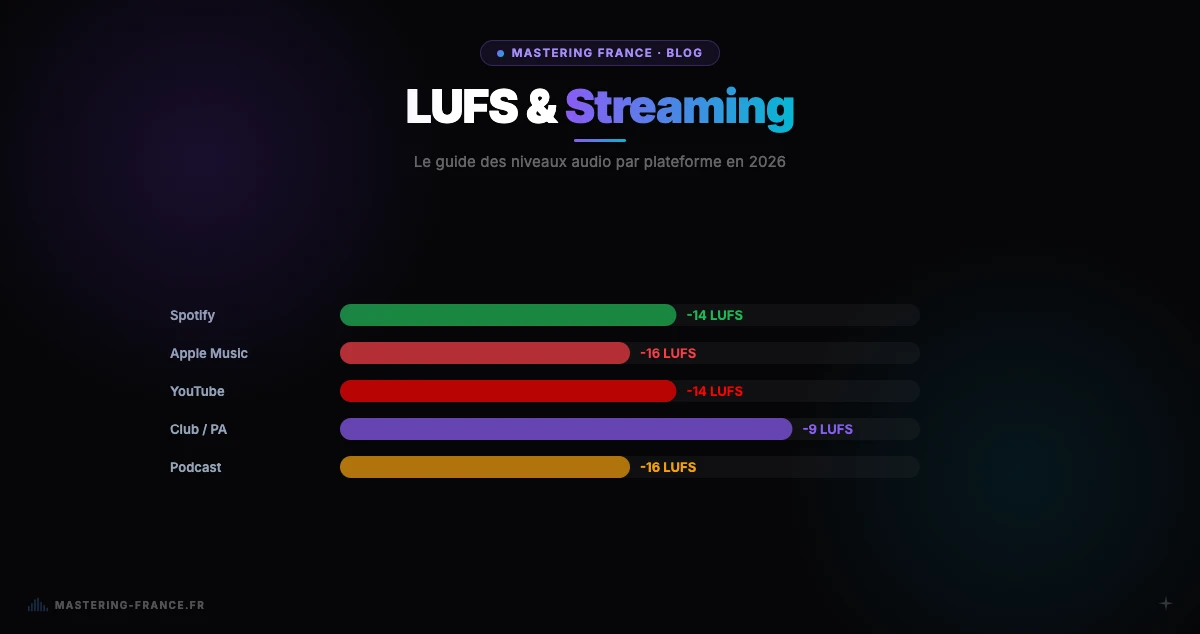
- Integrated LUFS: between -8 and -6 LUFS (vs -14 LUFS for streaming)
- True Peak: -1 dBTP maximum — mandatory to avoid any distortion on the PA
- Mono sub-bass below 80–100 Hz — required for stereo PA systems
- Preserved dynamics: moderate compression ratio to keep transient punch
- Solid, controlled bass between 50 and 120 Hz
- Clear mids for melodic element legibility at high volume
- Precise upper mids (3-8 kHz) so hi-hats and effects cut through the mix
Punch: the absolute dancefloor priority
Why transients make all the difference
On a club system, it's the transient — the kick's attack, the clap, the snare — that creates the physical sense of power on the dance floor, far more than average loudness. An over-compressed master crushes these transients and sounds flat and impactless despite a high LUFS reading. That's why you often hear tracks that are "loud" but groove-less in clubs.
How to preserve transients
The key is using a longer attack time on the mastering compressor — between 30 and 100 ms — to let transients pass before compression engages. The limiter must be transparent (FabFilter Pro-L2 in 'Transparent' mode, Weiss Limiter) to avoid crushing kick peaks.
Bass: the most critical element
Mono sub-bass: the universal rule
Club PA systems often use central mono subwoofers. Stereo sub-bass creates phase issues on these systems, potentially canceling some frequencies — your bass disappears or sounds incoherent depending on where you stand in the room. In mono below 80–100 Hz, the sound is coherent and powerful on all systems.
Symptoms of a poorly calibrated sub-bass
A poorly calibrated sub-bass can sound perfect at home and become muddy, distorted, or inaudible on a PA system. If your track sounds clean in the studio but 'growls' in the club, it's almost always an uncontrolled sub-bass issue between 20 and 60 Hz. Use a subsonic filter (cut below 20 Hz) to eliminate useless infra-bass that consumes amplifier power.
Do you need two masters — one streaming, one club?
Ideally, yes. Club mastering goals (-8 LUFS, loud, preserved dynamics) and streaming goals (-14 LUFS, automatic normalization) are different enough to warrant two separate versions. In a club, a streaming-mastered track will often sound too quiet — the DJ will have to raise the gain, with the quality risks that entails.
Mastering France offers both presets in the same workflow: the Club preset for label, distributor, and DJ submissions, and the Streaming preset for Spotify, Apple Music and Beatport streaming. With the Starter or Pro subscription, both versions are accessible at no additional cost.
Common club mastering mistakes
Over-compressing to "sound loud"
Excessive compression crushes the kick and snare transients — exactly what creates groove on a dancefloor. A club master should be loud IN LEVEL but not necessarily heavily compressed. Preserved dynamics are what deliver physical impact.
Ignoring True Peak
On an amplified PA system, even a micro-overshoot of True Peak at 0 dBTP can cause audible distortion on speakers. -1 dBTP is not a recommendation — it's an absolute requirement for club.
Not testing on a system capable of reproducing sub-bass
Your studio speakers probably don't reproduce below 40–50 Hz. If you master without hearing real sub-bass, you risk putting too much or too little. Always test on a system with a subwoofer, or use a reference headphone capable of going low (Beyerdynamic DT 990, AKG K702).
How to test your club master before release
- Test on a system capable of reproducing sub-bass (subwoofer + full-range speakers)
- Check mono: switch to mono and confirm bass remains present and coherent
- Listen at high volume: distortion and phase issues don't reveal themselves at low volume
- Compare with same-genre references at equal LUFS level
- Verify True Peak with Youlean Loudness Meter before delivering to DJs
- If possible: real-world test on a PA system or in a partner club
With Mastering France's Club preset, your track is calibrated around -11 LUFS, with preserved transients and True Peak below -1 dBTP — ready for any professional PA system. Try it free with your first track.