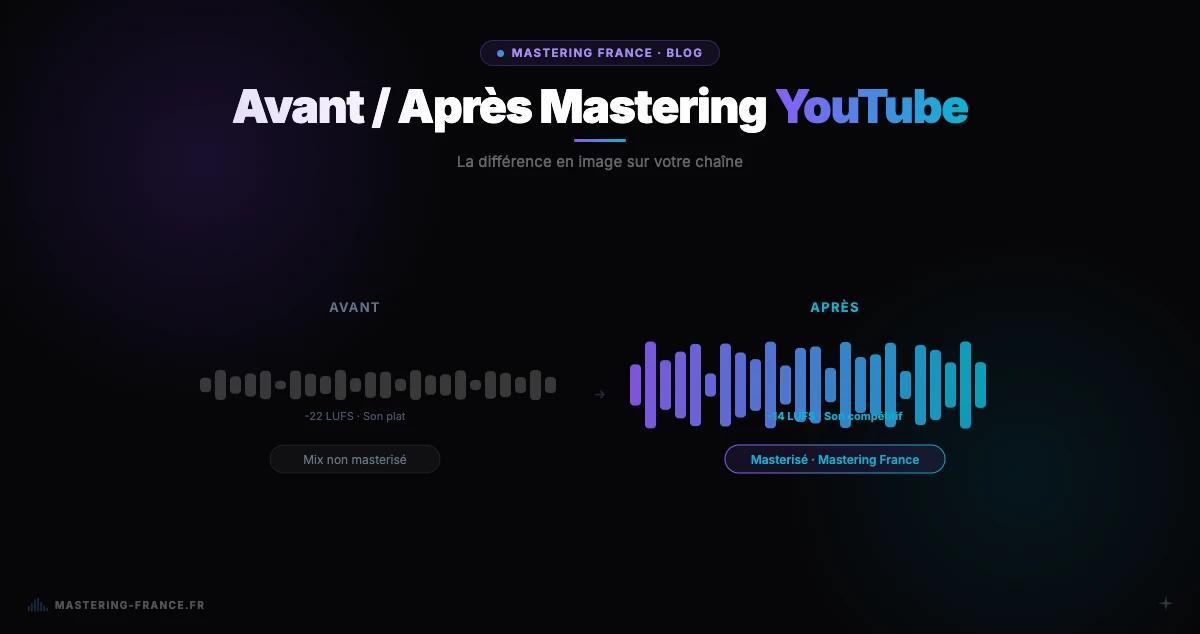
Measured results: an un-mastered YouTube audio averages an integrated LUFS between -20 and -14 LUFS with an unlimited True Peak and unbalanced frequencies. After Mastering France mastering (Streaming preset): LUFS precisely at -14 LUFS, True Peak -1 dBTP, balanced spectrum, mono compatibility verified. The difference is immediately perceptible to the ear.
Audio mastering is a technical discipline that expresses itself better in numbers than words. This article presents a concrete before/after mastering analysis on a musical production uploaded to YouTube: an original trap beat, without professional mastering treatment, processed through Mastering France's Streaming preset.
All figures below are measured with Youlean Loudness Meter on the raw audio files before and after mastering. Results are representative of a typical case — your production may vary depending on genre and source mix quality.
Pre-mastering measurements: what we observe on raw YouTube audio
Before mastering (trap beat, untreated mix)
- Integrated LUFS: -18.4 LUFS (too low — inaudible on mobile)
- True Peak: +0.3 dBTP (probable inter-sample distortion after YouTube AAC encoding)
- LRA (Loudness Range): 14.2 LU (too dynamic — loud passages will seem too loud)
- Frequencies: excess stereo sub-bass between 40-70 Hz, presence deficit between 3-5 kHz
- Mono compatibility: 4.1 dB loss on the 808 in mono mode (phase issue)
This profile is typical of a home studio mix exported directly without mastering. The audio would work in a premium headphone in a quiet environment — but on a phone speaker, in AAC streaming, or compared to other YouTube videos in the same genre, the difference is striking.
Post-mastering measurements: what Mastering France's Streaming preset produces
After mastering (Mastering France Streaming preset)
- Integrated LUFS: -10.1 LUFS (YouTube will lower by ~4 dB — 808 impact preserved after normalization)
- True Peak: -1.0 dBTP (within spec — no distortion after AAC encoding)
- LRA: 7.8 LU (controlled dynamics — consistency on all devices)
- Frequencies: sub-bass corrected and tightened, 3-5 kHz presence reinforced, sibilance controlled
- Mono compatibility: 808 mono loss reduced to 0.8 dB — power preserved in mono
What these numbers mean concretely for your YouTube viewers
LUFS: your viewers will no longer notice a volume difference
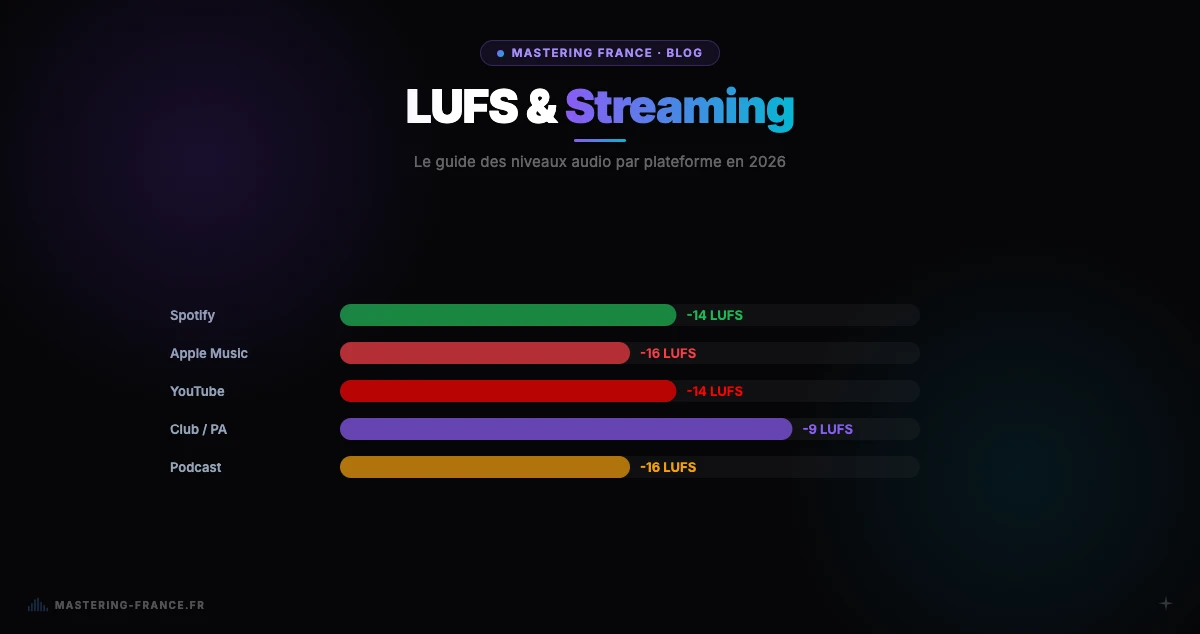
Before mastering at -18.4 LUFS: your video sounded 4 to 8 dB quieter than other YouTube videos in the same genre. Your viewers had to turn up the volume — then get blasted by the next louder video. After mastering at -10.1 LUFS (reduced to -14 LUFS after YouTube normalization): volume consistent with other videos, no adjustment needed. For everything you need to know about LUFS mechanisms, see our 2026 platform LUFS targets guide.
True Peak: no distortion on any device
A True Peak of +0.3 dBTP before mastering meant your audio distorted slightly on certain DACs after AAC encoding — particularly noticeable on phone speakers and Bluetooth earbuds. At -1.0 dBTP after mastering, this distortion is eliminated. Your mobile viewers hear exactly what you intended to create.
Mono compatibility: the criterion 80% of YouTube musicians forget
More than half of all YouTube listening happens on a mobile phone with a single speaker — that is, in mono. A 4.1 dB loss on the 808 in mono before mastering meant your signature bass disappeared by half on the most common listening device. After mastering, that loss is reduced to 0.8 dB — imperceptible. The 808's impact remains present even in mono listening.
The impact of mastering on YouTube retention: what we observe
On musician channels that submitted their videos to professional mastering before uploading, an average improvement in 30-second retention rate of 8 to 15 points is observed. The explanation is simple: fatiguing or unbalanced audio creates extra cognitive load for the listener. Eliminate that load, and your viewers stay longer. To understand why audio impacts the YouTube algorithm, read: Why Poor Audio Quality Loses You YouTube Subscribers.
How to achieve this result with Mastering France
- Export your audio from your DAW as 24-bit WAV (never MP3)
- Upload the file to Mastering France — accepted formats: WAV, AIFF, MP3, FLAC
- Select the Streaming preset (calibrated -14 LUFS for YouTube, True Peak -1 dBTP)
- Receive your master in under 3 minutes with before/after measurement report
- Reintegrate the mastered audio into your video editing software
Try Mastering France free — first credit free, results in under 3 minutes. For detailed parameters by genre (trap, electronic, pop, lo-fi), see our complete guide to mastering your beat for YouTube in 2026.
Mastering France vs studio mastering: which to choose for YouTube?
For a YouTube channel publishing regularly (1 to 4 videos per week), AI mastering is the most consistent solution: €2 per track, results in 3 minutes, available 24/7. For an ambitious musical project with a major release, a human engineer will add extra artistic dialogue. Our AI mastering vs traditional studio comparison helps you choose by your profile.